Grab your tea (or something stronger, no judgement here), settle in, and let me tell you where a rather unexpected new character came from this week. It began, as these things often do for me, at 35,000 feet.
Where My Characters Really Come From
People often ask me where I find my characters, and the honest answer is: absolutely everywhere. This time, it was on a flight to Vienna.
Somewhere over the clouds, I found myself rather distracted by one of the air stewards. Tall. Muscular. Blond. A jawline you could sharpen a pencil on. Honestly, he looked like he’d wandered straight off a longship and into a smart uniform. A Viking, unmistakably, just very well turned out and serving me a drink.
Naturally, I told my children and grandchildren about him the moment I landed. Naturally, I got the eye rolls. Apparently, there comes an age at which a woman is meant to stop noticing a fine jawline when it walks past with a drinks trolley. I have decided I disagree with this rule entirely, and I’d encourage you to do the same.
A few days later, over tea and rather a lot of cake with a fellow author friend, I was still talking about him. As these conversations tend to go, “wasn’t he handsome” slowly turned into “wouldn’t he make a wonderful character,” and by the time the pot had gone cold, an idea had well and truly hatched.
Back home, I couldn’t let it go. I gave him a name, a history, a reason for turning up in a Cornish fishing village of all places, and a whole back story that I am, for now, keeping firmly to myself. He’s already making his way into the new Cornish mystery series I’m working on.
The only question left is what role he’ll play. Charming newcomer? Prime suspect? Someone’s inconvenient ex? I genuinely haven’t decided yet, and I rather like keeping you guessing along with me. Keep an eye out for him.
That’s all from me this week. Thank you, as ever, for reading, for rolling your eyes at me alongside my grandchildren, and for coming along on this Cornish detour with me.
Cosy murder, cups of tea, and the odd body on the beach
Dear reader,
Welcome back. Settle in, because there’s rather a lot to catch up on this week: a real-life honour for a very fictional crime scene, a confession about starting over, and favourite authors. Let’s get into it.
🐾 Sprite’s Corner
In which Paige Harper’s ever-loyal Norfolk Terrier shares her thoughts
Sprite trotted into the kitchen this morning very pleased with herself, tail going like a metronome, and announced (in the way only a small dog with strong opinions can) that Exmouth Beach — yes, that Exmouth Beach, the one where Paige nearly ruined a good pair of boots investigating a body washed up on the beach in Murder on Exmouth Beach — has just been named the best beach in the whole of the UK and Ireland.
It’s official: the AA ranked it top of 228 Blue Flag beaches, praising the paddleboarding, the kitesurfing, and the sheer number of cafés along the front. Sprite, predictably, cares only about the cake crumb potential. Paige, is delighted for the town, though she did mutter something about hoping this summer’s day-trippers don’t go digging where they shouldn’t.
“Best beach in the country,” Sprite said, settling into a sunbeam. “Fewest bodies, ideally.”
On Knowing When You’ve Taken a Wrong Turn
I’ll let you in on something I’ve been sitting with this month. The new novel — the one set in Cornwall — wasn’t working. I could feel it for weeks before I let myself admit it: scenes I was avoiding, a plot I kept having to prop up with explanation, a main character I didn’t much want to spend time with. All the warning signs were there, and I ignored every single one of them, the way you do when you’ve already sunk a lot of time into something.
Eventually I stopped pretending. I put the draft aside and started again, properly, from the beginning. It’s a strange kind of relief and a strange kind of grief at the same time — all those words, gone. But I’ve learned, book after book, that this is simply how it works for me. It happened with Paige. It happened with the forensic artist. There were several versions of both of those series that never saw daylight, false starts I abandoned because they weren’t quite right, before the story I actually meant to tell finally showed itself.
I don’t find my stories by planning them perfectly – if at all! I find them by writing wrong versions over and over until the right one appears.
So here’s my question for you this week: what have you started — a book, a job, a garden, a relationship, anything — where you realised partway through it wasn’t going right, and were brave enough to begin again? I’d love to hear about it. Just hit reply.
A Time Machine
Which authors would I’d love to meet, living or dead? On the crime side, I’d happily corner Karin Slaughter, Jonathan Kellerman or Kathy Reichs at a festival and not let them leave. But if I genuinely had a time machine, there’s only one name on my list: Sue Grafton. It was Kinsey Millhone — sharp, funny, entirely her own woman — who first made me fall for female sleuths, right back with A for Alibi. Every Paige Harper mystery owes her something. I’d love the chance to tell her so.
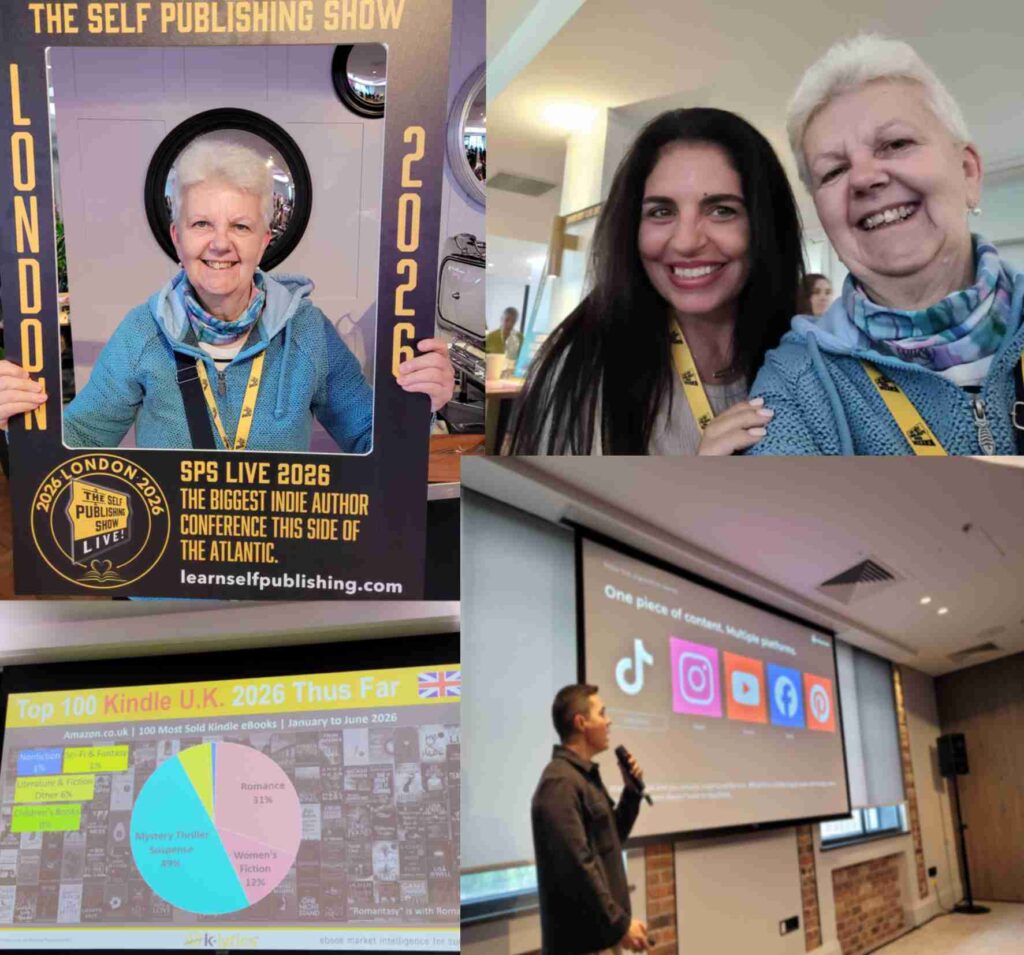
I have just collapsed into my favourite armchair with an enormous cup of tea and the very satisfying tiredness that comes after a genuinely wonderful few days. My notebook is covered in scribbles, my head is buzzing with ideas, and I have a stack of bookmarks and a heart full of inspiration — all thanks to the Self Publishing Show in London. I’ve added pics of me looking like an angel with a halo, a pic with Cissy Mecca, a romance author, Marvin Wey presenting on using BookTok and one of the graphs showing the current Kindle market in the UK.
I wanted to share everything with you while it’s still fresh, so settle in — this week’s letter is a good one.
✎ This Week’s Story
London Calling: Two Days at the Self Publishing Show
On the 11th and 12th of June I headed to London for the Self Publishing Show — and what an event it was. Two days packed with seminars, workshops, conversations, and the warm, slightly chaotic energy that only a room full of passionate independent authors can produce.
I came away having learned something new, useful, or genuinely mind-expanding from every single session I attended. Here’s a little flavour of what I soaked up:
Workshop
BookTok · led by Marvin Wey
I’ll confess I’ve been a little intimidated by TikTok — all that filming and editing feels a long way from sitting quietly at my desk inventing murders! But Marvin made it feel genuinely approachable. The message was simple: authenticity wins. Readers on BookTok want to connect with you, not a polished marketing machine. I came away with a list of ideas and at least a small portion of courage.
Workshop
Translation · led by James Blatch
As my readers know I published my first French translation last week. James spoke about the translation process and how big the German market is for translated works. Will I try it? Not sure. I’m defintely going to try the Spanish market. I had the pleasure of meeting other translators, including Maria from Ediciones Pluma Negra, who translates Rachel McLean into Spanish. The global cosy mystery market is thriving — and translations too.
Workshop
Library Markets · led by Dan Wood
Libraries have always felt like natural territory for cosy mysteries — I love a library, and so does Paige! Dan’s session on getting indie titles into library lending systems was a revelation. There are more routes than you’d think, and the thought of readers curling up with a Paige Harper borrowed from their local library is a genuinely lovely one.
Seminar
What Genres Are Selling · led by Alex Newton
Now this one I found particularly energising. Alex presented a fascinating data-driven look at which genres are performing well right now — and where reader appetites are heading. Without giving too much away, cosy mysteries remain wonderfully popular, and the insights on how readers discover series will definitely be informing some of my thinking about the new project I’m quietly working on.
Highlight of the Weekend ★
Meeting Rachel McLean
But the absolute highlight — the moment I’ll be telling people about for months — was meeting Rachel McLean. She is one of my favourite authors, and I have read and admired her work for years. She was warm, generous, and exactly as brilliant as I hoped. I may have been ever so slightly star-struck. Her presentation on How to avoid burnout was heartfelt and a warning to us all who try to take on too much.
In short? I came home buzzing. Two days of learning, connecting, and being reminded why this community of indie authors is so very special. Watch this space — I have plans.
✍ From the Writing Desk
What’s Coming Next…
As many of you know, I am quietly working on a new series — something distinct from the Paige Harper world, though I promise it will have the same warmth, wit, and satisfying puzzles you’ve come to expect from me. The sessions at the Self Publishing Show have given me a great deal to think about in terms of where the new project is heading. I’m not ready to share details just yet, but the notebook is filling up nicely, and I can feel the momentum building. You’ll be the first to know when I have news.
📚 The Paige Harper Mysteries
If you’re new here — welcome! The Paige Harper Mysteries is a five-book cosy mystery series following amateur sleuth Paige Harper and her wonderfully opinionated Norfolk Terrier, Sprite. Clever puzzles, warm characters, and communities you’ll want to move into. Whether you start from the very beginning or dive in at Murder at the Match, you’re in safe hands.
What an exciting week it has been at Tipper HQ! I’ve been wanting to share this news for quite some time, and I’m absolutely thrilled that the day has finally arrived. Pour yourself something comforting — a cup of tea, perhaps, or indeed a café au lait — and settle in. There’s quite a lot to tell.
Feature
Now Available
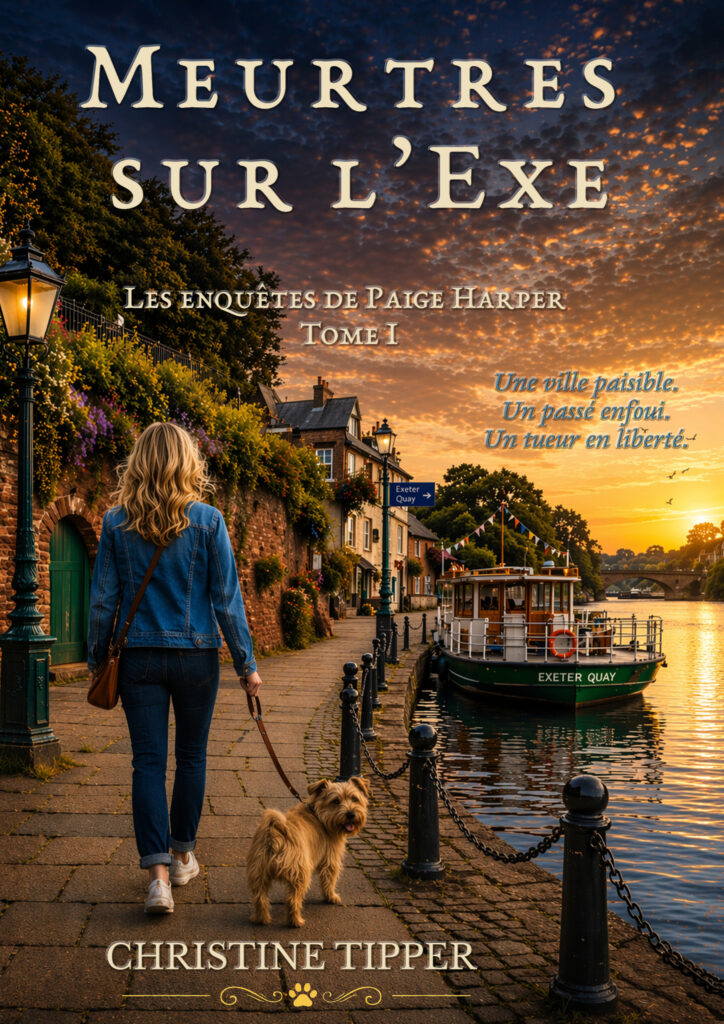
Meurtres sur l’Exe :
les enquêtes de Paige Harper
The French edition of Exe River Murders
Paige Harper parle français!
I am beyond delighted to announce that Exe River Murders — the first adventure in the Paige Harper Mysteries — is now available in French as Meurtres sur l’Exe : les enquêtes de Paige Harper. It genuinely still makes me smile every single time I see that title on the screen.
What makes this release particularly special — and rather close to my heart — is that I translated the book myself. Before I ever became a novelist, I spent many years working as a professional literary translator, and that career shaped not just how I write, but how I think about language, character, and the rhythms of a good story.
Literary translation is one of the most demanding and rewarding crafts I know. It is never simply a matter of swapping words between languages; it is about capturing the spirit of a story — the wit of a character, the atmosphere of a place, the particular way a sentence lands on the ear. When you are translating someone else’s work, you carry enormous responsibility. When you are translating your own, it becomes something altogether different: an intimate conversation with yourself across languages.
Rendering the Exe Valley into French — those winding riverbanks, the damp autumn light, the very particular English cosy atmosphere — was a challenge I absolutely relished. Some things translate beautifully. Others require ingenuity, patience, and the occasional cheerful argument with a bilingual dictionary. I hope French-speaking readers will feel entirely at home with Paige, even as she moves through a very English world.
“Translating my own book felt like meeting Paige Harper all over again for the first time — only this time, she was speaking to me in French.”
If you have friends or family who read in French — or if you are a French speaker yourself and have been waiting patiently — please do share the news. Paige (and Sprite!) would be delighted to reach a wider audience. For the moment, it’s available as an ebook. Plans for a paperback version are afoot.
Between celebrating the French launch and keeping Sprite away from the review copies, I’ve also been quietly beavering away on something entirely new. A new series is taking shape — characters, settings, threads of a mystery — and I am very excited about where it is heading. This week I’ve been writing the confrontational scene between the killer and the investigator. It certainly raised my heart beat a notch or two. More news in due course. I promise it will be worth the wait!
As always, thank you for being part of this community. Your warmth and support mean the world to me — and to a certain small Norfolk Terrier who considers herself very much part of the correspondence.
There is something genuinely thrilling about seeing your books look the way you always imagined they should. This week I have exciting news to share — the Paige Harper Mysteries have fresh, beautiful new covers, and I cannot wait to tell you all about the journey that led me here.
✦ Fresh Faces for Paige Harper
It is official — all five books in the Paige Harper Mysteries series now have brand-new covers, and I am utterly delighted with them. If you have been following along for a while, you will know the old covers were perfectly fine — but fine is not the same as right. These new designs feel like home. They feel like Paige.
The new covers carry a warmth and a cosiness that I always hoped would come through on the page — that sense of a close community with secrets, a cup of tea gone cold because something dreadful has happened along the quay, and a determined woman (and a very opinionated Norfolk Terrier) who simply will not leave well enough alone.
✦ The Indie Learning Curve — What They Don’t Tell You
When I first started self-publishing, I believed — naively, bless my heart — that writing the book was the hard part. The book was the easy part. The publishing part? That is a whole other education.
Here are some of the biggest lessons I have learned along the way:
Covers
Readers do judge books by their covers — because how else are they supposed to judge them before they have read them? Your cover is your first and sometimes only chance to say, this is the kind of book I am. It needs to match the genre expectation so clearly that the right reader recognises themselves in it immediately. A cosy mystery cover should feel cosy. It took me two cover redesigns to truly understand that.
Blurbs
Writing a blurb is its own peculiar craft. It is not a summary. It is a promise, a mood, a whispered invitation. I’ve spent an embarrassing amount of time writing blurbs that described my plots in meticulous detail, and then wondering why readers aren’t clicking “buy”. I’m still learning.
Keywords & Categories
Keywords and categories are the invisible architecture behind discoverability. You can have the most gorgeous cover and the wittiest blurb in the world, but if the algorithms cannot find you — or worse, are placing your cosy mystery next to hard-boiled thrillers — you are shouting into the void. I would encourage any indie author to invest real time in researching where their book truly belongs in the virtual shelves. It makes an enormous difference.
The indie publishing path is not always glamorous — there are spreadsheets, and algorithms, and moments where I wonder whether I should have stuck to watercolour painting and mosaics. But I would not trade it. The creative control, the direct connection with readers like you, and the sheer satisfaction of watching a series grow on your own terms — it is worth every bewildering moment.
And on that note — the new covers are a direct result of everything I have learned. I hope you love them as much as I do.
Each week, Paige Harper’s irrepressible Norfolk Terrier, Sprite, shares a few words. We make no apologies for her opinions.
Right. I have been asked to weigh in on these new book covers, and I shall not hold back.
Paige and I spent considerable time looking at the new designs together. She spread them out on the kitchen table — which, I would like to note, meant there was no room for my afternoon biscuit, and someone will be hearing about that — and we studied them very carefully.
My verdict: they are excellent. They look exactly right. Cosy. A little mysterious. The sort of cover that makes you want to curl up somewhere warm and read until it is far too late. Paige said she felt proud and I agree.
I also wish to register, for the record, that I believe a Norfolk Terrier of my distinction being prominent on every cover will boost sales tremendously.
— Sprite 🐾
✦ What’s Next?
I cannot say too much just yet, but I am deep in the early stages of a brand-new series. Different characters, a new setting, and a fresh set of puzzles — though I promise you the same warmth, wit, and the occasional cup of tea gone cold at a crime scene. More details to come as things take shape!
Thank you, as always, for being part of this little community of readers. Your enthusiasm means more than I can say. Do share the new covers with anyone you think might enjoy Paige and Sprite’s adventures — and do feel free to reply to this newsletter. I love hearing from you.
Hello, lovely readers! Welcome back to another week of mystery, mayhem, and the occasional biscuit. It’s been a busy one here, and I have lots to share — from a seaside adventure with a certain sulky Norfolk Terrier, to some wonderful new books that I think you’ll absolutely devour. Let’s dive in!
A message from the real boss
🐾 Sprite’s Corner
Sprite here. I have allowed Paige to borrow the keyboard for a moment, but I shall correct her version of events shortly.
This week, Paige and I made a special trip to Exmouth Beach — and yes, eagle-eyed readers of Book 4 will recognise it immediately. I’m pleased to report that, unlike our last visit within the pages of the series, we did not stumble across a dead body. Paige was visibly relieved. Personally, I had mixed feelings — a good mystery does get the nose going.
However, I must register a formal complaint: the beach was packed. Absolutely heaving. Families with ice cream. Children with kites. Dogs — well, other dogs, who were all perfectly pleasant, I suppose — bounding about everywhere. I had precisely three inches of personal space and had to share my favourite patch of damp sand with a toddler who seemed to think my tail was a toy.
Despite the indignity of the crowds, I must admit — the sea air was rather glorious. The waves were satisfyingly dramatic, the seagulls kept a respectful distance (they know better), and Paige bought chips. She gave me a chip. I forgave her for the crowds. Mostly.
We’ll be back, Exmouth. Just perhaps at dawn next time. — Sprite 🐾
What’s new in the world of cosy crime
📚 Fresh Reads & New Releases
There’s nothing quite like a fresh stack of cosy mysteries to brighten a week, and the genre has been delivering some absolute gems lately. Here’s what has been catching my eye — and keeping me up far past my bedtime.
Featured read
The Frozen People
by Elly Griffiths | Ali Dawson Mysteries, Book 1
I’ve been a huge fan of Elly Griffiths ever since Ruth Galloway first appeared on the scene, so when she launched a brand-new series, I cleared my diary immediately. The Frozen People introduces us to Detective Ali Dawson, who leads a cold case team with a rather extraordinary secret: they can travel back in time to gather evidence. So far so intriguing — but this first assignment takes Ali further than she has ever dared go before, all the way back to 1850s London in the depths of a freezing Victorian winter.
She’s there to clear the name of an eccentric patron of the arts suspected of involvement with a deeply sinister group called The Collectors — men who, rumour has it, had to commit murder simply to join. Ali arrives to find a dead woman at her feet and far too many unanswered questions. And then, back in the present day, her son Finn finds himself in serious trouble of his own. Could the two cases be connected?
It’s clever, atmospheric, and enormous fun — Griffiths has always had a gift for making the historical feel utterly alive, and Ali is a wonderfully messy, warm, compelling character. It was a Sunday Times bestseller and I can see exactly why.
❄️ A thought for the heatwave… Given England’s rather extraordinary temperatures right now, there’s something deliciously appealing about a novel set in a freezing Victorian winter with frost on every cobblestone. Consider this your literary air-conditioning.
The good news? The second Ali Dawson mystery, The Killing Time, is already on its way. Watch this space — and your wishlists.
🍰 Culinary Cozies — For Lazy Days & Lazy Beaches
Is there anything better than a cosy mystery that also makes you hungry? The culinary corner of our beloved genre is absolutely thriving at the moment, with a wonderful crop of foodie whodunits perfect for tucking into alongside an actual tasting session. I’m not a great cook, but I love reading about food. Why not try out a recipe?
A Fashionably French Murder by Colleen Cambridge
Set in 1950s Paris — which is already a dream — this one follows Tabitha Knight investigating a death at a fashion house, all while navigating a rather delicious friendship with a certain Julia Child. The food descriptions alone are worth it. Perfect beach bag material if you have ambitions of feeling very sophisticated while reading under a parasol.
The Bainbridge Island Mysteries by Lynn Cahoon
A bookseller-turned-sleuth, a cranky food critic found dead by the marina, and a whole island full of culinary suspects. Lynn Cahoon has brought her trademark warmth and wit to this newer series, and it’s proving absolutely irresistible. Bonus: the protagonist has a rescue cocker spaniel called Watson, which will delight all dog-loving readers among us. (Sprite has been informed and is reserving judgement.)
My suggestion this week
Why not make your reading into a proper occasion? Pick your culinary cosy of choice, prepare a little something that matches the theme — French pastries for Paris or a seafood platter if you’re channelling the Bainbridge marina — and settle in for an afternoon of gloriously guilt-free murder. Life is short. Eat the pastries. Read the book.
From the writing desk
✍️ What’s Brewing
I know, I know — you want news about the new series. Last week I hit what I call ‘the sticky middle’. I’d written the build up chapters, knew where I wanted to end up and got stuck. I felt clueless. How could I bridge the gap between where I was and where I wanted to be? After some intense brain-storming, and a fair amount of panicking, the pieces of the puzzle clicked into place. Phew!
Don’t forget to visit the website for all the latest news, the full Paige Harper series, and updates on what’s coming next.
Welcome back — and thank you, as always, for sharing a little of your week with me. I’ve been thinking about you all more than usual this week, because what I want to talk about touches on something rather delicious: the art of not being seen.
✦
Hidden in Plain Sight
Decades ago I attended a workshop for language teachers. The person running the session handed everyone a text written in a language none of us could read, and asked us to make sense of it — to find the subject, the noun, the verb. We threw ourselves into the puzzle. We dissected sentences, compared word shapes, looked for patterns. It was the kind of concentrated, slightly panicked analysis that only a room full of teachers can produce.
When we’d quite exhausted ourselves, the workshop leader looked around the room and asked, very quietly: “How many of you looked at the picture?”
“The answer was there all along. We’d simply been told where to look — and so we looked in entirely the wrong direction.”
I have never forgotten that moment. And it is, I confess, at the very heart of everything I do when I write a murder mystery.
As a writer, my job is not simply to conceal — it is to direct. To give you something bright and interesting to look at over here, while planting something quietly significant over there. A clue that is hiding in full daylight, perfectly visible, simply waiting for the moment when you look back and say: oh. Of course.
I’ve just finished a book where the killer was revealed through a single, breathtaking detail: the dog didn’t bark when the murderer entered the room. Set during the night, when dogs are deep in their own dreams, it barely registered — until it did. Utterly, gloriously clever. The clue was there. We simply weren’t looking.
A Little Confession
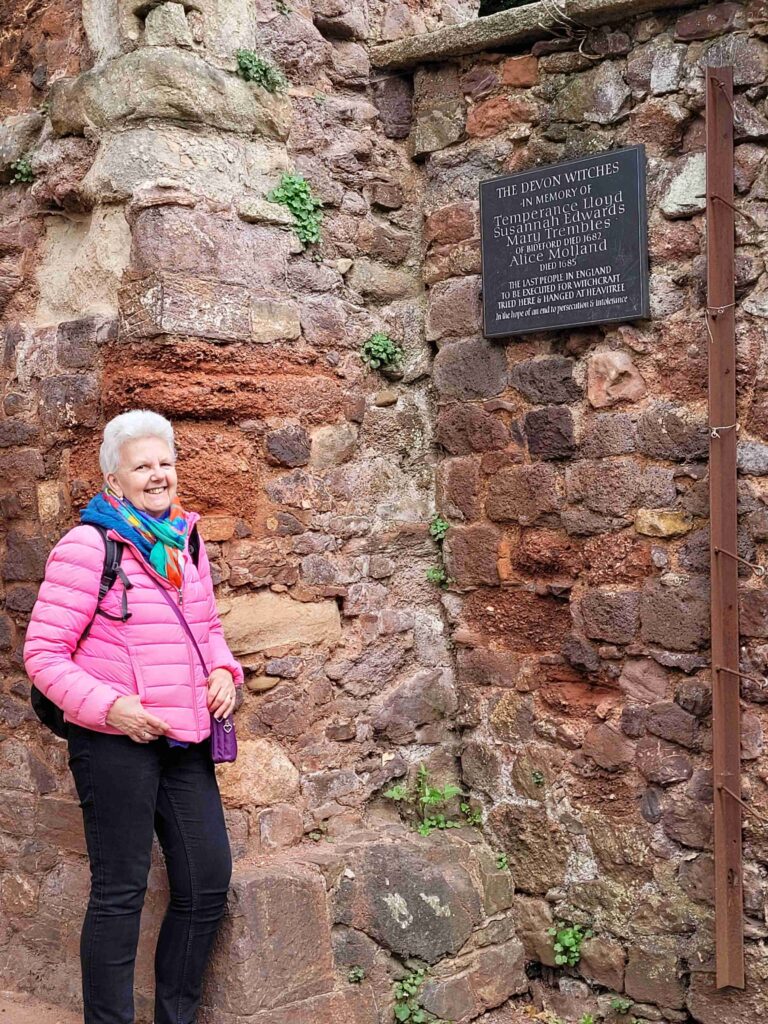
Last week’s challenge — asking you to identify which book features the Rougemont Castle gatehouse — contained exactly this kind of hidden clue. Did you find yourself looking at me in my rather splendid bright pink jacket? How many of you thought to zoom into the photograph and read the plaque on the wall behind me? The answer was there. Right there. In plain sight.
This is why I love this genre so very much. It is a collaboration — between writer and reader, between what is shown and what is seen. The best mysteries don’t cheat. They simply know where your eyes will go.
✦
A dispatch from
🐾 Sprite’s Corner
Hello, dear friends. Sprite here. Norfolk Terrier. Paige’s devoted companion and, if I may say so, her most astute investigative partner.
This week, Paige and I have been to St Sidwell’s Community Centre in Exeter, and what a lovely outing it was. There were humans of all sorts — my very favourite kind of gathering — and the smells were simply extraordinary. I conducted a thorough investigation of every corner, as any responsible terrier would, and I am pleased to report that nothing suspicious went undetected. Paige seemed to enjoy herself enormously too, though she spent rather more time talking than sniffing, which I feel is a missed opportunity.
I do love Exeter. There are always interesting things to observe. And — as Christine was just saying — one must always look carefully. You never know what you might find hiding in plain sight.
Until next time — nose to the ground, eyes wide open. 🐾
✦
Find Me Online
For more about The Paige Harper Mysteries — and to keep an eye on what I’m cooking up in that new series — do visit me at:
Cosy mysteries, gentle adventures, and one very curious terrier
This Week · Tuesday, 12 May 2026
Hello dear reader,
There is something quite particular about wandering familiar streets in the company of an old friend. Memories tumble out at every corner, half remembered and half re-imagined, and you find yourself laughing about things you had not thought of in years. That is precisely the day I had yesterday, and I could not wait to share it with you.
My friend came down to Exeter for the day, and we set ourselves the lovely task of revisiting the corners of the city that have woven their way into my writing. Exeter is a city that wears its history lightly. The Roman walls, the cobbled lanes, the cathedral close where the rooks gossip from the lime trees — it all has a way of slipping into a story when you least expect it.
This week’s wander
Returning to Rougemont
We began, as one really must, at the top of Castle Street, where the old gatehouse of Rougemont Castle stands quietly above the bustle of the High Street. It is easy to walk past it. Most do. But pause beneath that weathered Norman arch and a thousand years of footsteps press in around you — soldiers, sheriffs, prisoners, judges, and now, of course, the occasional novelist with a notebook.
I will admit I had a slightly proprietorial feeling about the place this time, because a pivotal scene from one of the Paige Harper Mysteries unfolds right there at the gatehouse. I shan’t say which one — that would spoil the fun. But I would love to know if you can guess.
A little puzzle for you
Which of the five Paige Harper Mysteries features a scene at the Rougemont Castle gatehouse? Cast your mind back through Paige’s adventures and see if you can place it. I would so love to hear your guesses.
From the gatehouse we drifted down through the side streets and out across the Cathedral Green, where I took an awful selfie that she’s begged me not to share.
What struck me most, walking those familiar lanes, was how a place changes when you bring a story to it. I cannot pass certain doorways now without seeing my characters in them. A bench by the city wall is forever the bench where a particular conversation happened. A shop window reminds me of a clue. Writing has spoiled me in the loveliest way — it has layered Exeter with ghosts of my own making, and I am terribly fond of every one of them.
I have been quietly tucking observations away for the new series, too. Old friends are very good for that. They notice things you have stopped noticing, and they ask the sort of questions that send a writer scuttling for her notebook.
🐶 Sprite’s Corner
A nose for adventure
Paige and Sprite spent a glorious afternoon at Rougemont Gardens this week, and I am reliably informed it was a tremendous success on all fronts. The wisteria is just past its best but still putting on a show, the lawns are at that particular shade of early-summer green that makes you want to lie down on them, and the benches are well placed for the contemplation of important matters — sandwiches, mostly, if you ask Sprite.
For those new to us, Sprite is Paige’s Norfolk Terrier — a small, sturdy, opinionated little soul with the soft heart of a poet and the focused determination of a very small hunting dog who has just remembered she is, in fact, a very small hunting dog. She made the acquaintance of a Spaniel called Bertie, conducted a thorough investigation of a particularly interesting hedge, and had what Paige can only describe as a meaningful moment of eye contact with a squirrel.
If you have not yet visited Rougemont Gardens, do put it on your list. There is something about that pocket of green tucked beneath the old castle walls that feels rather like stepping into a chapter of a book — which, of course, it has been.
From the writing desk
A new series stirring
A little update on the new series — it is coming along nicely, though I am keeping the details close for now. What I can say is that this week’s wanderings have left me with at least three useful ideas, two pages of scribbled notes, and one very strong suspicion that a particular character is about to do something I had not planned for her at all. That is usually a very good sign.
I shall share more as soon as I am allowed to. In the meantime, do let me know which novel you think the Rougemont gatehouse scene comes from. And if you have a favourite spot in Exeter that you would like to see Paige and Sprite visit one day, tell me that too. I keep a list.
How a portrait artist in Swindon reminded me that the best clues are hiding in plain sight
———
I went to a talk last week that hasn’t quite left me. It’s been rattling around my head ever since, the way a good idea does when it’s looking for somewhere to land. And since it hasn’t landed yet, I thought I’d share it with you and see where it takes us.
The talk was in Swindon, given by the portrait artist Duncan Shoosmith. If you haven’t come across his work, I’d encourage you to look him up — he’s a seriously talented painter with a gift for capturing people as they really are, not just how they sit in a chair. He spoke about his process, the way he builds a portrait layer by layer, and I found myself completely absorbed. There’s something endlessly fascinating about watching someone explain how they see.
But the part that really caught my attention — the part I haven’t been able to stop thinking about — was when he talked about hands.
Any artist will tell you that hands are notoriously difficult to draw. All those angles. All those creases. The way fingers taper and curl and never quite sit still.
Duncan spoke about them with the kind of reverence you might reserve for a landscape or a dramatic sky. He described the challenge of getting them right — how a hand slightly too large or a finger slightly too stiff can throw an entire portrait off balance. But more than the technical challenge, what struck me was his conviction that hands carry as much character as a face. Perhaps more, because people don’t guard their hands the way they guard their expressions.
And that’s the thought that followed me home.
What Hands Give Away
As a writer, I spend a lot of time thinking about how people reveal themselves. Dialogue is the obvious place — what characters say and, more importantly, what they don’t. Body language comes in close behind. But hands? Hands are something else entirely. They’re a kind of unconscious autobiography.
Think about what a pair of hands can tell you about a stranger before they’ve said a single word.
Bitten-down nails might speak of anxiety, or impatience, or a restless mind with nowhere to go. Ink stains on the fingers could mean a journalist, an artist, someone who still writes longhand in notebooks. Rough, calloused palms suggest a life spent outdoors or in a workshop — a gardener, a carpenter, someone who builds things rather than talks about them. And then there are those immaculate, carefully manicured hands with not a cuticle out of place, which can tell you something about a person’s need for control, for order, for surfaces that say everything is fine here, nothing to see.
A wedding ring on a chain around someone’s neck rather than on their finger. Paint under the thumbnails that never quite scrubs away. A hand that shakes when it reaches for a glass. A hand that doesn’t shake when it should.
As readers, we pick up on these things instinctively. They feel real because they are real — we all read hands in daily life, even if we don’t realise we’re doing it. We notice the firm handshake and the limp one. We register the hand that hovers near a pocket, the one that grips a handbag strap too tightly, the one that rests easily on a table with nothing to hide.
The Writer’s Close-Up
In cosy crime — where the pleasure lies in the noticing, in piecing things together before the big reveal — hands are an absolute gift. A character who wrings their hands in one scene and clenches them in the next is telling you something long before they open their mouth. Are they nervous? Guilty? Trying very hard to hold themselves together? The reader gets to decide, and that’s part of the fun.
I love writing those small, telling moments. The suspect who drums their fingers on the table during questioning — not because they’re anxious, but because they’re bored. The witness who smooths their skirt over and over, as though the fabric might keep everything neat and tidy if they just press hard enough. The person who reaches out to touch someone’s arm and then pulls back at the last moment, the gesture aborted before it quite arrives.
And I especially love what hands can reveal about relationships. The way two people hold hands speaks volumes — fingers loosely linked and swinging, or white-knuckled and tight, or barely touching at all. And if someone doesn’t take the hand that’s offered to them? Well. Now you’ve got a scene.
Portraits and Pages
What I took away from Duncan Shoosmith’s talk — apart from a deep admiration for anyone who can draw a convincing thumb — is a reminder that the best details are the quiet ones. A portrait isn’t just a face. A character isn’t just dialogue. A mystery isn’t just a body in the library (though I do enjoy a good body in a library).
The richness is in the periphery. The story lives in the details that most people overlook — and hands, it turns out, are full of stories. They carry a person’s history, their habits, their secrets. A painter captures that on canvas. A writer tries to capture it on the page.
So here’s my challenge to you, whether you’re a writer or a reader or simply someone who enjoys a good puzzle: the next time you’re sitting across from someone — in a café, on a train, at a dinner party — have a look at their hands. What story do they tell? What do you notice that you might have missed?
You might find there’s a character in there somewhere, waiting to be written.
And if the hands in question happen to be clutching a Norfolk Terrier, a teacup, and a suspiciously underlined train timetable all at once — well, that’s probably just Paige.
Spring is properly here now, and I don’t know about you, but I always find this time of year puts me in the mood for a good cosy mystery. There’s something about the longer evenings and the first warm cups of tea taken outside that makes me want to curl up with a book full of quirky characters, charming villages, and just the right amount of peril. Sprite, my loyal writing companion, has been making the most of the garden — terriers and fresh air are a winning combination — and I’ve been making the most of some wonderful new reading.
This week, I want to take you on a little trip across the Irish Sea. Ireland has always held a special place in my heart, and the cosy mystery scene coming out of the Emerald Isle right now is absolutely thriving. So grab your favourite mug, settle in, and let me introduce you to two Irish treats that deserve a spot on your reading list.
Featured Author
Lucy Connelly
The Mercy McCarthy Mysteries
If you haven’t yet discovered Lucy Connelly, you are in for a real treat. Lucy writes under this pen name (she also writes as Candace Havens), and her Mercy McCarthy Mystery series is the kind of reading that makes you want to pack a suitcase for the west coast of Ireland — even if your only means of transport is your imagination and a well-stocked Kindle.
The series is set in the fictional village of Shamrock Cove, where Mercy and her twin sister Lizzie have inherited a charming antique bookshop from their grandfather. Mercy is a crime writer herself, a coffee lover, and the kind of protagonist you’d want as your next-door neighbour — unless, of course, you happened to be a murderer, in which case she’d be the last person you’d want poking around. Right from the first book, An Irish Bookshop Murder, Mercy finds herself at the centre of village intrigue when a neighbour drops dead on his own doorstep and, with his final breath, accuses her of the deed. Nothing like a good wrongful accusation to get the sleuthing started!
One of the things I particularly love about this series is Mercy’s relationship with the local detective, Kieran. It’s built on trust and mutual respect, and it develops naturally across the books — no forced dramatics, just a genuine partnership that grows warmer with each instalment. There’s also Mr. Poe, Mercy’s dog, who is apparently inspired by Lucy’s own real-life pet. Any series that gives a dog a meaningful role in the proceedings is a series after my own heart. (Sprite would approve, naturally.)
The series now runs to five published books, with a sixth on the way later this year. Here’s the reading order if you want to start from the beginning:
1.An Irish Bookshop Murder (2024) 2.Death by the Book (2024) 3.Death at Inishmore Castle (2025) 4.Murder on the Clock (2025) 5.A Body at the Irish Book Club (2026) 6.A Body at the Bakery (coming November 2026)
What makes Lucy’s writing stand out in the cosy mystery world? For me, it’s the sense of place. Shamrock Cove feels real — you can almost smell the sea air and the fresh scones. The mysteries themselves are well-plotted and satisfyingly twisty, but never so dark that they spoil the warmth of the setting. And there are running storylines threaded through the background of the series that reward readers who follow from the start, even though each book works perfectly well as a standalone.
Lucy is also the author of the Scottish Isle Mystery series (written under her Candace Havens name), and she’s recently announced a new Welsh Village Mystery series as well. If you love cosies set in the British Isles, this is a writer who clearly shares that passion and writes with genuine warmth and a sharp eye for a good puzzle. Her readers are devoted — retired librarians, lifelong mystery fans, and everyone in between — and there’s a lovely community building around her books.
I’d recommend starting with An Irish Bookshop Murder and letting yourself be swept along. You’ll be through all five before you know it.
Book of the Week
A Plot to Die For
by Ardal O’Hanlon • Published 7 May 2026 • Simon & Schuster
Staying with the Irish theme this week, my Book of the Week pick is one I am genuinely excited about: A Plot to Die For by Ardal O’Hanlon. Yes, that Ardal O’Hanlon — Father Dougal from Father Ted, star of Death in Paradise and Derry Girls, and one of Ireland’s best-loved comedians. But don’t let the celebrity name fool you into any snobbery. Ardal is a serious and accomplished writer with two previous novels under his belt, including the acclaimed The Talk of the Town, which was featured in the reference guide 1001 Books You Must Read Before You Die.
A Plot to Die For is the first in a planned mystery series — called the Blooming Murder Mysteries — and it introduces us to Finn O’Leary, a celebrity gardener with his own TV show in London. Finn has returned to his Irish hometown of Abbeyford to care for his ageing mother, nursing a broken heart after the end of his marriage. He’s barely unpacked before the locals rope him onto the Tidy Towns committee — a competition that, as anyone who knows Ireland will tell you, is taken with deadly seriousness. And then, at his mother’s choir practice, one of the singers drops dead mid-song. Suddenly Finn, along with his mother, her Nigerian carer Happiness, and a local teacher called Aoife, finds himself at the heart of a murder investigation in a town full of secrets.
What I find most appealing about this book is the tone. Ardal brings his comedian’s instinct for timing and absurdity, but wraps it around a properly constructed mystery with real emotional depth. The early reviews have been glowing, with critics praising the way he blends light comic touches with keen observations on contemporary small-town Irish life. It sounds like the perfect marriage of cosy crime warmth and intelligent wit — exactly the kind of thing that, as a fellow cosy mystery writer, I find both inspiring and thoroughly enjoyable to read.
The book is published on 7 May, so you can pre-order now. I’d say this is one to watch — and I wouldn’t be surprised if Finn O’Leary becomes a firm favourite with cosy mystery readers everywhere.
From My Writing Desk
What I’ve Been Up To
On the home front, work on my new series is coming along nicely. I can’t say too much just yet (a mystery writer has to keep some secrets), but I will say that the process of building a new world and new characters from scratch is both thrilling and slightly terrifying in equal measure. After five books with Paige Harper and the ever-faithful Sprite, stepping into fresh territory feels a bit like moving to a new village — exciting, unfamiliar, and full of possibility.
Speaking of Paige, I know many of you have asked about the Paige Harper Mysteries and whether there might be more to come. I love that these characters and stories still mean so much to so many of you. For now, the five-book series stands complete, but never say never in the world of cosy crime. Paige and Sprite have a way of nudging their way back into my thoughts when I least expect it.
If you’re new here and haven’t yet met Paige, her Norfolk Terrier Sprite, or the rest of the gang, you can find all five books on my website. There’s nothing quite like a completed series to binge-read on a spring weekend.
The Cosy Corner
Why Ireland Does Cosy Crime So Well
It struck me this week, while putting this blog together, just how naturally Ireland lends itself to cosy mystery fiction. It’s a country built on storytelling, where every village has its characters and its secrets, where the landscape is dramatic enough to provide atmosphere without needing to resort to anything too grim, and where humour runs through everything like a seam of gold through rock. The tradition of the Irish local pub, the village fete, the community event where everyone knows everyone — these are the building blocks of great cosy crime.
Both Lucy Connelly and Ardal O’Hanlon tap into this beautifully in their own ways. Lucy’s Shamrock Cove feels like a place you’d want to live (murders notwithstanding), and Ardal’s Abbeyford captures the particular intensity of small-town rivalries and the warmth that sits alongside them. If you’re a reader who loves setting as much as story, Irish cosies are well worth exploring.
I’d love to hear from you — are there other Irish cosy mysteries you’ve enjoyed? Drop me a message through my website. I’m always on the lookout for recommendations, and I suspect many of your fellow readers are too.
Thank you so much for reading this week. Whether you’re deep into a Mercy McCarthy marathon or eagerly awaiting Finn O’Leary’s debut, I hope there’s something here to add to your reading pile. Until next time —
 CHRISTINE TIPPER